Teachers and their unions or associations make great scapegoats for what the U.S. populace perceives as the poor state of education. As teachers, especially elementary teachers, have been asked to do more with less over the last 20 years criticism from politicians, community leaders, and parents has skyrocketed. A profession that in years past was respected, is now met with derision and claims of mass incompetence. Educators who have decided to leave the classroom and take administrative positions get in on the act berating their faculties for whatever deficiencies they can find while asking teachers to do ever more for their students.
If indeed there is a crisis in education today it is convenient to blame teachers. That lets a lot of others off the hook. The first group it lets off the hook is parents. Poor parenting is one of the root causes of low student achievement, ask any teacher. No one dares point a finger at parents. No one dares to ask, "Are Johnny's parents helping him at home and making sure he gets to school on time?". No one asks why parents do not feed their children, make sure they get enough sleep, or learn English. Students' first teachers are their parents and the losses that stack up from 0 to age 5 are nearly impossible to make up.
The other group let off the hook is students themselves. Society refuses to acknowledge that students have a choice. By the age of 8 children can decide how to behave and whether to put forth their best efforts. Furthermore, they can tell you if and why their work is poor. Students must take responsibility for their own learning. Teachers can present the material standing on their heads, on SmartBoards, with videos, whatever, but if students refuse to engage there is little teachers can do.
Money. The root of all evil according to some but certainly a crucial part of a quality education. Education has never been fully funded. Facilities, textbooks, supplies, and modern technology all require money that is never available. We have enough money to spend four years repairing a stealth bomber but not enough to educate our children. Our leaders can blame teachers rather than themselves for starving education of the money required for a quality system. If our representatives had to work in the kinds of environments and with the kinds of tools teachers do, they would grant themselves plenty of funding to upgrade their workplace.
Blaming teachers takes heat off of the politicians and bureaucrats who approve and write the standards, make the testing rules, and of course decide the budgets. If children fail to achieve mastery of the standards with the approved methods perhaps the standards and methods should be re-evaluated. The Common Core standards were initiated and approved by a gathering of states' governors. While these standards may be fine, why are career politicians making educational policy? Why are career politicians dictating how material shall be presented in the classroom? Those same people decide how much money schools can spend and how it can be spent. Using teachers as political scapegoats allows politicians to avoid the blame for underfunding education. Teachers and their unions are directly responsible for schools' lack of funds with their huge salaries and pensions. That's the message put out there by our elected officials.
Poverty. There it is, the huge elephant in the room that none of our representatives wants to seriously address. Most children living in poverty are not going to achieve the same kind of academic success as their middle-class counterparts. Until this country acts to bring the millions out of poverty, no new standards or methods will be able to lift student achievement to the levels desired. No lunch or breakfast program is comprehensive enough to alleviate the deficits caused by homelessness, lack of early childhood experiences, or changing schools every few months. A pastry in the morning isn't enough to compensate for poor nutrition or absent parents.
Parents, students, lack of money, education policies dictated by politicians, and poverty. These are some of the causes of low student achievement. Hold them accountable and then teachers can actually do their jobs. Blaming teachers is easy but not at all productive.
Thursday, March 20, 2014


Tuesday, March 18, 2014
New Standards, Old Books
Recently the Los Angeles Times ran two days worth of editorials praising the new Common Core standards developed by state governors. The editorial staff likes the idea that the new standards emphasize problem solving and writing. They like the fact that the new standards are touted as an improvement over the last 10 years or so of teaching a mile wide and an inch deep.
I cannot disagree with any of that. So much of my teaching career was taken up with teaching a skill one time in the school year and never repeating it that I wholeheartedly agree with adding depth to the curriculum. Teaching kids to think is also a wonderful objective. Many of today's school children find thinking and problem solving require just too much effort. That seems to be the attitude of many parents as well who find raising responsible children requires too much effort.
The problems with the Common Core are not the standards themselves but the way they are being implemented. As is usual in education, the way the new standards are implemented is like testing pasta for readiness: throw some at a wall and see if it sticks. Since no materials are aligned with the new standards teachers are asked to create curriculum and materials. Most teachers aren't trained in curriculum development and are certainly not paid to do it.
The Los Angeles Times editorial makes much of teachers' opposition to these new standards. Well, who can blame them? Again teachers are asked to embrace a new program without being consulted or provided the materials critical to implementing a new program. No textbooks have been written to align with Common Core. It is unconscionable that teachers are required to teach a curriculum with no textbooks. Let's ask surgeons to operate with steak knives. But in education it is always thus.
The editorials also comment on teachers not liking change and that older teachers who have been doing the same thing for years just want to keep on doing it. Who are the people who write these editorials? Firstly, teachers probably change what they do more than anyone else. Every year some new program comes along requiring new training and ways of teaching. Secondly, older teachers have seen and implemented more changes than younger teachers and are more able to identify what works and what doesn't. All new educational programs have components that are substandard, just ask any teacher. Experienced teachers more easily identify these components and modify them to increase their effectiveness.
Let's wait until Common Core textbooks and materials are in all the schools before we criticize teachers for being less than enthusiastic about standards for which they now have to write curriculum.
I cannot disagree with any of that. So much of my teaching career was taken up with teaching a skill one time in the school year and never repeating it that I wholeheartedly agree with adding depth to the curriculum. Teaching kids to think is also a wonderful objective. Many of today's school children find thinking and problem solving require just too much effort. That seems to be the attitude of many parents as well who find raising responsible children requires too much effort.
The problems with the Common Core are not the standards themselves but the way they are being implemented. As is usual in education, the way the new standards are implemented is like testing pasta for readiness: throw some at a wall and see if it sticks. Since no materials are aligned with the new standards teachers are asked to create curriculum and materials. Most teachers aren't trained in curriculum development and are certainly not paid to do it.
The Los Angeles Times editorial makes much of teachers' opposition to these new standards. Well, who can blame them? Again teachers are asked to embrace a new program without being consulted or provided the materials critical to implementing a new program. No textbooks have been written to align with Common Core. It is unconscionable that teachers are required to teach a curriculum with no textbooks. Let's ask surgeons to operate with steak knives. But in education it is always thus.
The editorials also comment on teachers not liking change and that older teachers who have been doing the same thing for years just want to keep on doing it. Who are the people who write these editorials? Firstly, teachers probably change what they do more than anyone else. Every year some new program comes along requiring new training and ways of teaching. Secondly, older teachers have seen and implemented more changes than younger teachers and are more able to identify what works and what doesn't. All new educational programs have components that are substandard, just ask any teacher. Experienced teachers more easily identify these components and modify them to increase their effectiveness.
Let's wait until Common Core textbooks and materials are in all the schools before we criticize teachers for being less than enthusiastic about standards for which they now have to write curriculum.
Monday, February 24, 2014
Old Dogs
Mickey
is an old dog about whom I’ve written more than once, usually in concert with
other family dogs. He is a miniature American Eskimo, a huge white 14 year old
hairball. He weighs in at 23
pounds which, as you will see, has become a problem. Age has affected Mickey in some physical ways but has not
affected his personality. Basically he hates people, especially people in his
backyard. The ankles of the guy who cleans the pool and the gardener are both
targets for his vicious attacks. He has attacked the ankles of friends of ours
despite our pleas to stay in the house, don’t turn your back on him, and never
try to pet him.
But
here’s the thing about Mick today, he is now mostly blind and deaf and weirdly
doesn’t always recognize us which is a little odd considering we’re the only
people he’s ever liked. He’s also pretty gimpy with arthritis. Walking,
running, and going up and down stairs requires some concentration. Regardless, he
still gives the pool guy a run for his money when he enters and leaves the yard
threatening to bite holes in his net since he can’t quite get a bead on his
ankles anymore.
He can’t find his
dog food unless it’s right in front of him but he can sense the squirrel cavorting on the back wall and scare it up
a tree. In the house he doesn’t know where I am even if I’m talking to him,
unless I wave my hand in front of his nose but somehow “sees” me through the window when I come down in the morning to feed
him. He even tells time, beginning his ‘feed me’ yips precisely at 4 pm every
day.
Open the front
door and Mickey won’t venture outside. I think there are two reasons for that.
The first is that it requires negotiating 3 steps to get there and other is
that he can’t see what’s out there. Just like lots of old people his world has
become very circumscribed. He cruises the backyard and the downstairs of the
house. Beyond that he’s not taking any chances.
Worst of all Mickey
is crazy, demented, senile, nuts, whatever you call it when an old dog loses
his mind. I’ve had a few old dogs but never one that was senile. My vet says
there are supplements to try, but forcing pills down the throat of a 100 year
old dog seems a little harsh. It’s hard enough to find ways to get his daily
pain pills down.
Mickey lives
outside. He likes it that way. He comes in the house to see if he can cadge
some food but if none is forthcoming stands at the slider waiting to be let
out. Out is where he is most comfortable in his fur coat and also where the
trouble starts. Our yard includes
a pool, some grass, concrete, and most importantly a raised deck at the shallow
end of the pool. Two shallow steps lead up to the deck which is also framed with a short
wrought iron fence.
Bear in mind that
Mickey has lived in this yard his entire life. We haven’t changed anything. But suddenly, for no particular
reason I can discern he has become flummoxed by the two steps and the deck. He
gets up on the deck, I don’t know how, and can’t get down! I look out the
kitchen window and there he is running back and forth along the fence and
around the deck unable to get down.
I
come out of the house and call to him and even go over to the steps but nope,
he’s not coming down. Those are
steps to the great unknown and he’s not about to set even one paw on them. I try to convince him to come close
enough that I can grab his collar and gently pull him down the first step. But
he’s on to me now that I’ve done it a couple of times and backs away when I come toward him. My
only recourse is to pick him up, one arm around his rear, the other around his
chest, and set him gently below the steps. He is then deliriously happy and runs off to the water bowl
to celebrate his freedom.
However, he is
heavy and bulky and not always cooperative. So between his girth and my own
arthritic knee it’s a chore getting him up and down and set down gently. I wish
I could teach him how to walk around the pool to get back to the patio but this
is one old dog who’s not learning any new tricks.
Thursday, August 8, 2013
Text to Self
In the course of reading, reading anything at all really, we make connections between the text or reading material and ourselves. Unfortunately, not all of these connections are productive or positive.
This morning the LA Times carried a story I've followed about a man and his dogs. Out in the Antelope Valley two pit bulls attacked and killed a woman out for a walk in her neighborhood. The man had 4 pit bulls and knew they were dangerous but did not make sure they were fenced in. In fact the dogs routinely roamed the neighborhood scaring the residents. The two dogs were euthanized, the owner faces criminal charges, and the other two dogs are being rehabbed for adoption.
I've kept track of this story only because I read the paper every day, not because I go looking for it. It's also a story that sticks in your head. There are so many dogs out and about and so many owners who think their dogs don't require leashes that it's easy to identify with this story.
This morning I put on my pink and blue Nikes, my headphones, and my shades and headed out to walk the neighborhood exercising my arthritic knee. Upon leaving the house I noticed two large dogs roaming the street. I don't know what kind of dogs they were and I didn't recognize them. One had a collar. They looked like boxer/pit bull mixes but I don't really know. Since they were sort of hanging around one house I thought perhaps they belonged to the neighbors.
I continued to walk across the street and they started to show some interest in me and began moving toward me. Normally I'm not afraid of dogs, but am cautious about strange dogs. I'm not stupid. However, with the article about the murderous pit bulls fresh in my mind I turned around and headed back toward my house. Honestly I thought about going on, about how ridiculous I was being but I stepped back anyway. What a wuss!
In the not too distant past I purchased some pepper spray online to defend myself and my dogs against other aggressive dogs. I'd had a couple of close calls with unleashed dogs. But I stopped carrying it and had to do a quick search of my cupboard to find it. It was behind my recipe box, a green cylinder with a red spray button. I made sure I remembered how to use it and left the house again.
This time the dogs were closer to my house and one trotted over to follow me down the street. He gave up after a few yards and turned around to find his friend. I walked swiftly down the street and around the corner and when I got back the dogs were gone. Probably back in their yard.
Did I feel foolish? Kind of. As far as I know no one around here has been mauled by a dog in at least 10 years. Like lots of horrific news stories I took that one and applied it to myself. In that I'm not alone. Newspapers, TV news outlets, and other media would have us believe that the world is a very dangerous place. In fact our society is far safer today than ever before. We are not likely to be kidnapped, stabbed, shot, or mauled by dogs.
Every time we make a connection between ourselves and the horrors reported by the media we are incited to fear our fellow man - or dogs as the case may be. Caution is a good thing. Being alert to one's surroundings is also smart. But letting that caution morph into fear and affect our actions isn't so smart and it's pretty stressful too. Thinking of ourselves as prey will not make us safer just more anxious.
This morning the LA Times carried a story I've followed about a man and his dogs. Out in the Antelope Valley two pit bulls attacked and killed a woman out for a walk in her neighborhood. The man had 4 pit bulls and knew they were dangerous but did not make sure they were fenced in. In fact the dogs routinely roamed the neighborhood scaring the residents. The two dogs were euthanized, the owner faces criminal charges, and the other two dogs are being rehabbed for adoption.
I've kept track of this story only because I read the paper every day, not because I go looking for it. It's also a story that sticks in your head. There are so many dogs out and about and so many owners who think their dogs don't require leashes that it's easy to identify with this story.
This morning I put on my pink and blue Nikes, my headphones, and my shades and headed out to walk the neighborhood exercising my arthritic knee. Upon leaving the house I noticed two large dogs roaming the street. I don't know what kind of dogs they were and I didn't recognize them. One had a collar. They looked like boxer/pit bull mixes but I don't really know. Since they were sort of hanging around one house I thought perhaps they belonged to the neighbors.
I continued to walk across the street and they started to show some interest in me and began moving toward me. Normally I'm not afraid of dogs, but am cautious about strange dogs. I'm not stupid. However, with the article about the murderous pit bulls fresh in my mind I turned around and headed back toward my house. Honestly I thought about going on, about how ridiculous I was being but I stepped back anyway. What a wuss!
In the not too distant past I purchased some pepper spray online to defend myself and my dogs against other aggressive dogs. I'd had a couple of close calls with unleashed dogs. But I stopped carrying it and had to do a quick search of my cupboard to find it. It was behind my recipe box, a green cylinder with a red spray button. I made sure I remembered how to use it and left the house again.
This time the dogs were closer to my house and one trotted over to follow me down the street. He gave up after a few yards and turned around to find his friend. I walked swiftly down the street and around the corner and when I got back the dogs were gone. Probably back in their yard.
Did I feel foolish? Kind of. As far as I know no one around here has been mauled by a dog in at least 10 years. Like lots of horrific news stories I took that one and applied it to myself. In that I'm not alone. Newspapers, TV news outlets, and other media would have us believe that the world is a very dangerous place. In fact our society is far safer today than ever before. We are not likely to be kidnapped, stabbed, shot, or mauled by dogs.
Every time we make a connection between ourselves and the horrors reported by the media we are incited to fear our fellow man - or dogs as the case may be. Caution is a good thing. Being alert to one's surroundings is also smart. But letting that caution morph into fear and affect our actions isn't so smart and it's pretty stressful too. Thinking of ourselves as prey will not make us safer just more anxious.
Thursday, August 1, 2013
Birdless in Huntington Beach
Moving to Huntington Beach from Torrance some 20 years ago required some adjustments. My yard in Torrance was filled with roses, camellias, and gardenias. We had a vegetable garden that grew luscious tomatoes and crisp peppers. In other words, we had great soil. This house sits on soil contaminated by oil. It's hard dense clay and no matter how many times you amend it that wet clay seeps up and takes over. So when we moved here our gardening days ended.
However, we were rewarded by a backyard full of songbirds. The carrotwood trees we planted along with the ficus tree provided food and shelter for an abundance of birds. Redwing blackbirds and tricolor blackbirds were regular visitors to both the trees and our bird feeder. We also had the requisite sparrows building nests under the eaves of our patio. Once or twice we had a large gorgeous yellow headed blackbird on the back wall. Small hawks came to hunt sparrows who hid out in the ficus tree until the hawks got bored. Cormorants occasionally roosted, wings spread, in the trees as well.
After a few years all of the blackbirds were driven out by European starlings an aggressive non-native bird from...you guessed it Europe! The reedy banks of the lake in Central Park a block away which were home to the blackbirds were also taken over by the starlings. The starlings did come every year to eat the red seeds of the carrotwood trees which pop out of hard shells in the spring. They did such a good job that we never had seeds on the ground only the hard shells.
This year, for the first time in 20 years, we have no birds at all in our trees. The carrotwood trees dropped their seeds and shells in abundance only to be swept up and put in the trash. A trip to the park reveals a modest population of great-tailed grackles, a new addition to our area, but no starlings or blackbirds. There are mallards, Canada geese, and cormorants living there. Occasionally a mallard couple will try to take over our pool or a hummingbird will zip by but that's it for backyard birds.
I haven't consulted the Audubon Society to discover the reasons for changing bird populations but I can't help but think that the absence of native birds in my own backyard is a subtle but notable sign of environmental damage. It feels empty and silent in my yard now even with the cars passing by behind the wall. The birds connected me to the natural world while living in world of concrete and slump stone.
Life's just not the same without birds in the yard.
However, we were rewarded by a backyard full of songbirds. The carrotwood trees we planted along with the ficus tree provided food and shelter for an abundance of birds. Redwing blackbirds and tricolor blackbirds were regular visitors to both the trees and our bird feeder. We also had the requisite sparrows building nests under the eaves of our patio. Once or twice we had a large gorgeous yellow headed blackbird on the back wall. Small hawks came to hunt sparrows who hid out in the ficus tree until the hawks got bored. Cormorants occasionally roosted, wings spread, in the trees as well.
After a few years all of the blackbirds were driven out by European starlings an aggressive non-native bird from...you guessed it Europe! The reedy banks of the lake in Central Park a block away which were home to the blackbirds were also taken over by the starlings. The starlings did come every year to eat the red seeds of the carrotwood trees which pop out of hard shells in the spring. They did such a good job that we never had seeds on the ground only the hard shells.
This year, for the first time in 20 years, we have no birds at all in our trees. The carrotwood trees dropped their seeds and shells in abundance only to be swept up and put in the trash. A trip to the park reveals a modest population of great-tailed grackles, a new addition to our area, but no starlings or blackbirds. There are mallards, Canada geese, and cormorants living there. Occasionally a mallard couple will try to take over our pool or a hummingbird will zip by but that's it for backyard birds.
I haven't consulted the Audubon Society to discover the reasons for changing bird populations but I can't help but think that the absence of native birds in my own backyard is a subtle but notable sign of environmental damage. It feels empty and silent in my yard now even with the cars passing by behind the wall. The birds connected me to the natural world while living in world of concrete and slump stone.
Life's just not the same without birds in the yard.
Wednesday, July 24, 2013
Ur / gent: adj., requiring immediate action or attention
My urgent care provider opens at 8:00 AM which I don't consider early since it's called urgent care which implies one needs medical attention before or after one's regular physician's hours. That day I'd been waiting anxiously at home since 5:30 AM. I arrived promptly at 7:55 for reasons which shall remain confidential and are unrelated to this post. I was the second person in line (8:01 to be precise) and we both had to fill out new patient forms. So far the two of us were neck in neck in the race to be seen. But at 8:00 AM there were only 3 people staffing the facility, 2 clerical workers and a health assistant, the guy, in this case, that takes your weight, blood pressure, etc. I know this because I followed them in. The other patient and I waited in silence for over 30 minutes after turning in our paperwork. Sometime after that a young man, the doctor, I presumed and the man for whom we were waiting, strode into the office and disappeared through the inner door. Then more waiting. Turns out he was a physician's assistant, no doctor ever showed up.
As I sat there I thought, albeit a little irritatedly, about the meaning of "opens at 8:00". The comparison between my job and theirs struck me. (I know I'm retired from teaching but I haven't developed amnesia!) Here, the staffers stroll in getting themselves settled before calling a name. No rush. And the person we're here to see doesn't even roll through the door until well after the posted opening time. Nothing "urgent" about this scene. No one is in a hurry except the patients. And as civilized adults we just wait and wait and wait, accepting apologies for having to wait so long just grateful to be seen after 1 1/2 hours!!!
Teaching is a little different as you well know. For one thing 8am is not that early. If school starts at 8am, faculty and staff have to be there 20-30 minutes beforehand and most arrive even before that. Teachers must "settle in" before their "clients" arrive not afterwards. Neither can we just saunter in 30 minutes after school starts. Try to imagine a long line of kids waiting calmly and quietly on the blacktop for their teacher to arrive. Nope, I'm not getting a visual of that.
Once our clients arrive they immediately begin clamoring for attention, no waiting quietly to be seen one a time. Instead they insist their needs and wants be met at once each jockeying to be first. And so it goes for the entire day, 25 -36 children in one room, each one demanding a teacher's undivided attention at some point. Mixed in with those kids are a few who require constant attention. Sometimes an emergency arises with a nosebleed, vomiting, or a child who conveniently forgets to come back from the restroom prompting a search and rescue operation. And let's not forget the ringing of the telephone with non-essential requests from the office in the midst of all this. It's like doing triage while performing surgery. A teacher's day begins at a run and ends with a sprint toward the finish line.
So from all appearances, despite protests to the contrary I'm sure, urgent care providers don't really understand the meaning of the word urgent. I wish I could explain it to them.
As I sat there I thought, albeit a little irritatedly, about the meaning of "opens at 8:00". The comparison between my job and theirs struck me. (I know I'm retired from teaching but I haven't developed amnesia!) Here, the staffers stroll in getting themselves settled before calling a name. No rush. And the person we're here to see doesn't even roll through the door until well after the posted opening time. Nothing "urgent" about this scene. No one is in a hurry except the patients. And as civilized adults we just wait and wait and wait, accepting apologies for having to wait so long just grateful to be seen after 1 1/2 hours!!!
Teaching is a little different as you well know. For one thing 8am is not that early. If school starts at 8am, faculty and staff have to be there 20-30 minutes beforehand and most arrive even before that. Teachers must "settle in" before their "clients" arrive not afterwards. Neither can we just saunter in 30 minutes after school starts. Try to imagine a long line of kids waiting calmly and quietly on the blacktop for their teacher to arrive. Nope, I'm not getting a visual of that.
Once our clients arrive they immediately begin clamoring for attention, no waiting quietly to be seen one a time. Instead they insist their needs and wants be met at once each jockeying to be first. And so it goes for the entire day, 25 -36 children in one room, each one demanding a teacher's undivided attention at some point. Mixed in with those kids are a few who require constant attention. Sometimes an emergency arises with a nosebleed, vomiting, or a child who conveniently forgets to come back from the restroom prompting a search and rescue operation. And let's not forget the ringing of the telephone with non-essential requests from the office in the midst of all this. It's like doing triage while performing surgery. A teacher's day begins at a run and ends with a sprint toward the finish line.
So from all appearances, despite protests to the contrary I'm sure, urgent care providers don't really understand the meaning of the word urgent. I wish I could explain it to them.
Thursday, February 7, 2013
First Excursion
 |
| Where the rivers meet the sea. |
Mangroves – the word sounds a little dangerous, like a flesh-eating forest maybe. I looked it up and a mangrove is simply a tree that lives with its roots underwater. Pretty simple. A mangrove swamp is just a lot of those trees. So we took our first tour in the southern Pacific part of Costa Rica through the mangroves. I know I thought it would be a lot more interesting than it was. In the mangroves a little goes a long way. But on our way out we stopped by a tiny island inhabited by birds.
 |
| Frigate birds |
 |
| bird island |
The sea was choppy and the
ride out was rough. I’m sure I was at least three inches shorter by the time we
got to the mangroves. Every time the boat rode a wave up I came down hard. I could feel my vertebrae
compressing. Frigate birds roosted on the island as well as sea eagles and
black vultures. Interesting but
let’s get out of this chop!
 |
 Enter the mangroves where the
ocean meets fresh water. High tide marks are clearly visible on the trees. At
first it seems as if the mangroves are simply large rivers lined with trees but
further exploration up the rivers reveals a different world altogether.
Enter the mangroves where the
ocean meets fresh water. High tide marks are clearly visible on the trees. At
first it seems as if the mangroves are simply large rivers lined with trees but
further exploration up the rivers reveals a different world altogether.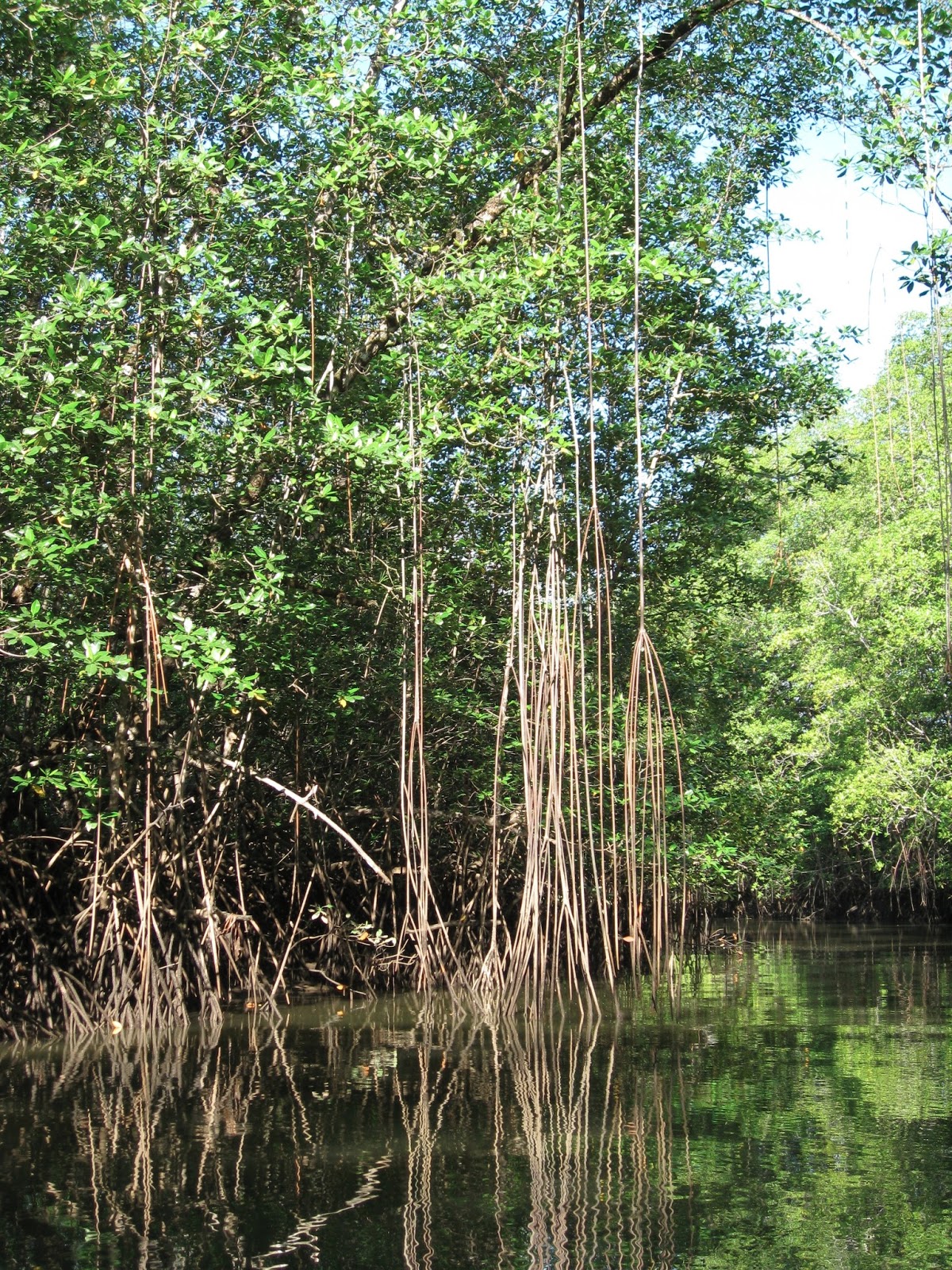 |
| Hanging roots |
The rivers narrow and the
exposed tree roots reveal a natural world more fantasy than science. Some roots
hang from above while others create a piece of art curving over and over in
endless repetition. Birds flit through the swamp and tiny hermit crabs skitter
across the dry roots. Caimans hide in plain sight waiting for a chance to slip
into the water.
 |
| Juvenile caiman |

Quiet is the word for a
mangrove. The river moves slowly out to the sea and rises and falls with the
tide. Insects do not buzz and
there are few animals in the narrowest canals of the mangrove. With the roots exposed
and dead looking the silence is eerie.
 |
| Artistic roots |
 |
| Tangled roots in a narrowing canal. |
Subscribe to:
Posts (Atom)