I hate to say it but it's true, people are pigs. In no way do I intend to demean pigs, who are clean, intelligent animals, by comparing them to people. Instead I use "pig" as it has come to mean a person who is crude, uncouth, dirty, and gluttonous.
I know about the public because my house backs up to relatively busy street. The noise is nearly non-existent at night but during the day the traffic is fairly regular. The street is about 8 feet below the top of my ubiquitous slump stone wall. This morning I looked out of my bedroom window which overlooks the top of my patio cover and thus the street and discovered trash from a fast food place on top of the patio cover! Over the years we've had lots of odd trash thrown over the wall. Shell casings, food, bottles, and regular paper garbage. But to lob a bag of fast food trash onto the roof took a good arm and a purpose.
Somehow the trash in my yard always makes me wonder if we've been targeted for some reason. I think, "why my house?", "what did my dogs or I do to make me a target"? That's ridiculous I know. But it is disconcerting to find strange things in your yard and to think that some unknown person chose your house as his/her garbage dump.
I wonder, what kind of person throws his garbage into some stranger's yard? Female, male, young, or old? I have my suspicions but I like to give equal consideration to all people. So in honor of equal opportunity I put at least 75% of the public in the "pig" category. If you could see the large park near my house after a nice weekend I think you would agree. A pig sty is cleaner. And I put my money on the intelligence of pigs over the public any day.
Friday, October 14, 2011


Wednesday, October 12, 2011
Blogging for Kids
Having a blog myself, I thought it would be great if my fifth and sixth graders could get in on the action. My teaching partner (younger and more technically savvy than I) found a safe site that is private and can only be viewed by the administrator (me), the kids, and their parents. So every Monday we troop into the computer lab and write blogs. Of course first I had to educate them on what a blog is. Texting they get, blogging was new. So they go to a computer, type in the web address find their name and type their password. Ready, set, they can write their own blogs, read their classmates' blogs and even write comments. They get as much satisfaction out of reading other people's work as they do writing their own.
Doing this is more work for me which I neglected to consider beforehand, naturally. I have to read and approve every post and every comment before it can be published to the site. The blogs are pretty much limited to the number of kids but the comments...yikes! These kids love to comment. I might have 26 blogs to read and 50 comments. Most comments are kind and supportive I have to admit. But I have one child on the autistic scale who is honesty personified. I have to trash some of his comments like: "LAME!" or "Your grammar is bad!" or even "Why did you do something so stupid?" I may agree with his comments but in this case honesty is not the best policy.
I'm beginning to be afraid that our blogging is not long for the web. Just this week when we logged onto the site we started getting an automatic message from the school district that that site was restricted and could not be accessed. It did let us on, though that message remained in the background. If it does eventually kick us out I'll be royally pissed off. The district blocks so many sites already it's hard to use the internet as a research or teaching tool.
But in this case the site is safe and private and supervised so I can't see the problem. I think, wait, I know, the district just uses a broad hand to block sites without knowing anything about them. There is a lot of teaching that can go on while blogging. My kids already text each other and use Facebook without much instruction or supervision. So this is a great way for them to learn some good rules about using the internet for social exchanges.
The rules I have for blogging are good rules for all public internet sites. No trashing other people, no bad language, read it over before you send it, and be positive and kind toward others. No naming names either. Using people's names might be ok for this site because it's closed but they need to get in the habit of maintaining their privacy as well as the privacy of others online.
Their blogs are also good writing tools. They see first hand why spelling and punctuation and complete sentences are important when they read or try to read each other's unedited writing. They are starting to be more careful with spelling at least and recognize poor writing when they see it. It makes for a few good teaching moments. Writing skills taught with a light hand, very 21st century.
Most of all though, blogging is a good way to get kids interested in writing. They can write about whatever they want within certain limits. And they can write as little or as much as they want. They LOVE it. After they're done with their post they can't wait to read what other people wrote. Every writer wants someone to read their "stuff" and this is a great way for kids to have an audience for their work.
But, I'm waiting for the "block" to fall. Anything fun and interesting in education today is usually shut down as soon as the administration (dum de dum dum) gets wind of it. Until we're blocked though, the kids in room 15 can be found every Monday at a computer, writing, writing, writing.
Doing this is more work for me which I neglected to consider beforehand, naturally. I have to read and approve every post and every comment before it can be published to the site. The blogs are pretty much limited to the number of kids but the comments...yikes! These kids love to comment. I might have 26 blogs to read and 50 comments. Most comments are kind and supportive I have to admit. But I have one child on the autistic scale who is honesty personified. I have to trash some of his comments like: "LAME!" or "Your grammar is bad!" or even "Why did you do something so stupid?" I may agree with his comments but in this case honesty is not the best policy.
I'm beginning to be afraid that our blogging is not long for the web. Just this week when we logged onto the site we started getting an automatic message from the school district that that site was restricted and could not be accessed. It did let us on, though that message remained in the background. If it does eventually kick us out I'll be royally pissed off. The district blocks so many sites already it's hard to use the internet as a research or teaching tool.
But in this case the site is safe and private and supervised so I can't see the problem. I think, wait, I know, the district just uses a broad hand to block sites without knowing anything about them. There is a lot of teaching that can go on while blogging. My kids already text each other and use Facebook without much instruction or supervision. So this is a great way for them to learn some good rules about using the internet for social exchanges.
The rules I have for blogging are good rules for all public internet sites. No trashing other people, no bad language, read it over before you send it, and be positive and kind toward others. No naming names either. Using people's names might be ok for this site because it's closed but they need to get in the habit of maintaining their privacy as well as the privacy of others online.
Their blogs are also good writing tools. They see first hand why spelling and punctuation and complete sentences are important when they read or try to read each other's unedited writing. They are starting to be more careful with spelling at least and recognize poor writing when they see it. It makes for a few good teaching moments. Writing skills taught with a light hand, very 21st century.
Most of all though, blogging is a good way to get kids interested in writing. They can write about whatever they want within certain limits. And they can write as little or as much as they want. They LOVE it. After they're done with their post they can't wait to read what other people wrote. Every writer wants someone to read their "stuff" and this is a great way for kids to have an audience for their work.
But, I'm waiting for the "block" to fall. Anything fun and interesting in education today is usually shut down as soon as the administration (dum de dum dum) gets wind of it. Until we're blocked though, the kids in room 15 can be found every Monday at a computer, writing, writing, writing.
Thursday, October 6, 2011
Dear Steve,
In the eighties when my children were small and I was a stay at home mom we bought our first personal computer. I remember strange things like the fact that it cost $3500 and didn't come with a printer. I think it was an HP. I started a novel on it (never finished) but beyond that it seemed to me it didn't do much. My friend and I argued with her husband about how personal computers were useless and certainly not user-friendly. He had one of the first Apples but it didn't impress us. We couldn't foresee the day when the personal computer would be easy to use and the invention of the internet that would put the world at our finger tips.
The first Apple computers I encountered were the ones at my kids' school and then the ones at my own school. We loaded floppy discs into them to enable kids to word process and learn how to keyboard. I had a couple of the beige boxes in my classroom for kids to use. What was impressive was that children couldn't break them. These early Apples were indestructible. In my own house however, we continued to buy PC's because of the price and the fact that they were everywhere. Apple was pretty small in those days and largely confined to the educational market as far as I knew. Obviously, I'm not a technological visionary.
We bought several PC's over the course of the next years. It took at least an hour of hooking up scores of cables to boot it up and then the tower was noisy and hot. They all died of virus contamination eventually. One that my son owned even caught fire! But viruses and the software required to keep them out slowed down the computer enough that when you turned it on it took 10 minutes to boot up. You could make and drink coffee in that time. Many times in the middle of a project the PC simply froze and you couldn't do anything about it. It wouldn't shut down, return to the program, nothing. Just that damned black screen. That was the worst thing about PC's, their unstable platforms. The toll the viruses and anti-virus software took on our checkbook was pretty irritating too.
Then one day a 17" iMac, still in the box, arrived in my classroom. It was a thing of beauty with all the software and hardware contained in the monitor. It had a keyboard and a mouse and a cord. Five minutes to plug it in and I was good to go. I was in computer heaven. Here was a device that did everything I wanted it to do. The internet was fast, the graphics outstanding, and it was QUIET and cool. I was hooked. Not too long after that I convinced my other half that we should have one. We still have it in the den where not a single virus has plagued us. Nor do we have any anti-virus software to corrupt our hardware. Yes it was more expensive than a PC which was one of the reasons we had purchased PC's in the past. But the higher price has translated into a longer lasting device that has paid for itself. We've added more RAM and for a mere $30 updated the operating system. I use a Mac internet service so I can work at home and access it at school on my idisk and vice versa. I was and am a convert.
Now I'm an Apple freak. I use my iPod everyday to listen to books and music while driving, exercising or just doing boring household chores. I hate to drive my husband's car because it lacks a dock for my iPod. It stores loads of books and music and is reliable with a long lasting battery and plenty of functions. I also have a MacBook so I can shop while watching TV or write while sitting on the couch or in the kitchen as I am now. The battery life on this is amazing. I even have an iPad that I took to Europe so I could keep in touch. As you might imagine, Apple products litter my family room.
True, every once in awhile I get what I call "the spinning wheel of death". That multi-colored wheel that tells the user the computer is working. That's when the computer is "stuck". On a Mac you just hold down the on and off button and it shuts down, ready to reboot in about 10 seconds. Pure genius.
I thank Apple for pulling me along with them into the computer age with aesthetically beautiful products designed for all kinds of users, even not so savvy ones like me.
Your vision will be missed.
The first Apple computers I encountered were the ones at my kids' school and then the ones at my own school. We loaded floppy discs into them to enable kids to word process and learn how to keyboard. I had a couple of the beige boxes in my classroom for kids to use. What was impressive was that children couldn't break them. These early Apples were indestructible. In my own house however, we continued to buy PC's because of the price and the fact that they were everywhere. Apple was pretty small in those days and largely confined to the educational market as far as I knew. Obviously, I'm not a technological visionary.
We bought several PC's over the course of the next years. It took at least an hour of hooking up scores of cables to boot it up and then the tower was noisy and hot. They all died of virus contamination eventually. One that my son owned even caught fire! But viruses and the software required to keep them out slowed down the computer enough that when you turned it on it took 10 minutes to boot up. You could make and drink coffee in that time. Many times in the middle of a project the PC simply froze and you couldn't do anything about it. It wouldn't shut down, return to the program, nothing. Just that damned black screen. That was the worst thing about PC's, their unstable platforms. The toll the viruses and anti-virus software took on our checkbook was pretty irritating too.
Then one day a 17" iMac, still in the box, arrived in my classroom. It was a thing of beauty with all the software and hardware contained in the monitor. It had a keyboard and a mouse and a cord. Five minutes to plug it in and I was good to go. I was in computer heaven. Here was a device that did everything I wanted it to do. The internet was fast, the graphics outstanding, and it was QUIET and cool. I was hooked. Not too long after that I convinced my other half that we should have one. We still have it in the den where not a single virus has plagued us. Nor do we have any anti-virus software to corrupt our hardware. Yes it was more expensive than a PC which was one of the reasons we had purchased PC's in the past. But the higher price has translated into a longer lasting device that has paid for itself. We've added more RAM and for a mere $30 updated the operating system. I use a Mac internet service so I can work at home and access it at school on my idisk and vice versa. I was and am a convert.
Now I'm an Apple freak. I use my iPod everyday to listen to books and music while driving, exercising or just doing boring household chores. I hate to drive my husband's car because it lacks a dock for my iPod. It stores loads of books and music and is reliable with a long lasting battery and plenty of functions. I also have a MacBook so I can shop while watching TV or write while sitting on the couch or in the kitchen as I am now. The battery life on this is amazing. I even have an iPad that I took to Europe so I could keep in touch. As you might imagine, Apple products litter my family room.
True, every once in awhile I get what I call "the spinning wheel of death". That multi-colored wheel that tells the user the computer is working. That's when the computer is "stuck". On a Mac you just hold down the on and off button and it shuts down, ready to reboot in about 10 seconds. Pure genius.
I thank Apple for pulling me along with them into the computer age with aesthetically beautiful products designed for all kinds of users, even not so savvy ones like me.
Your vision will be missed.
Friday, September 30, 2011
Nuke It!
Technology makes itself obsolete before I can read the instructions on the device I just bought. New gadgets and electronics seem to appear everyday, designed to make our lives not only easier and more efficient but more fun too. We buy X-Boxes, Wii's, iPhones, iPads, 3-D TV's, and loads of other new and exciting stuff. You can purchase a fridge with a computer, an alarm clock that predicts the weather, and books with no paper. My vacuum cleaner even tells me when the carpet is clean. We have become so blase` about astonishing new inventions that nothing can surprise us anymore. A phone that reads bar codes and takes videos? So yesterday. Download a book in seconds? So what? Depending on your age you can't remember a time when technology didn't upgrade every nanosecond. Too bad really, because the excitement of discovering new technology is gone.
Can you remember when microwave ovens were first for sale? They were actually invented as a by-product of the war effort during WWII. But they were huge and not commercial. Even as they got smaller they were still not user friendly.

But then, a miracle. Do you remember your family's first microwave? I do. It was big and cumbersome and took up a huge amount of counter space. And the things it could do! Imagine cooking a baked potato in 5 minutes! Bacon could be had with a couple of paper towels and a plate. No more grease all over the stove. A real advantage to children whose job it was to clean the kitchen.
The real excitement (besides baked potatoes) was the way leftovers could be reheated plate by plate. No more pots and pans to scrub every night. We grew to love the nights I later called "scrounge" because everyone could have something different. We'd get out all the leftovers and make our own TV dinners. This box saved time, energy and money. It was amazing and exciting and everyone could use it. Microwaves weren't just for mom or dad, they were a family gizmo and you could experience the excitement of a 5 minute potato anytime you wanted.
Think about life without one. No reheated coffee or food. And think how long frozen dinners would take to cook. The frozen meal industry took off after the invention of the microwave. Before this, the only frozen food I ever ate was a Swanson's TV Dinner when my parents went out. What a treat that was and the food was pretty awful.
For a time, many of us tried to cook actual meals in the microwave. I cooked macaroni and cheese that boiled over every time. I had a fillet of sole recipe that looked promising but wasn't. We learned that rolls reheated became chewy but tortillas could be perfectly heated. Cooking vegetables in the microwave still produces edible meals. Still, reheating meals or cooking frozen meals remains the microwave's primary function I imagine.
The RadarRange, as the first ones were called, delivered on it's promise to make life easier and simpler. Moreover, the excitement this new technology generated was incredible. Recent technology is indeed more sophisticated but it hardly makes anyone's life simpler nor does it create the excitement of the microwave coming as it did at a time when modern electronics was in its infancy.
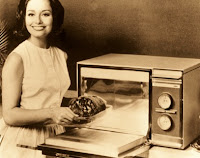
Can you remember when microwave ovens were first for sale? They were actually invented as a by-product of the war effort during WWII. But they were huge and not commercial. Even as they got smaller they were still not user friendly.

But then, a miracle. Do you remember your family's first microwave? I do. It was big and cumbersome and took up a huge amount of counter space. And the things it could do! Imagine cooking a baked potato in 5 minutes! Bacon could be had with a couple of paper towels and a plate. No more grease all over the stove. A real advantage to children whose job it was to clean the kitchen.
The real excitement (besides baked potatoes) was the way leftovers could be reheated plate by plate. No more pots and pans to scrub every night. We grew to love the nights I later called "scrounge" because everyone could have something different. We'd get out all the leftovers and make our own TV dinners. This box saved time, energy and money. It was amazing and exciting and everyone could use it. Microwaves weren't just for mom or dad, they were a family gizmo and you could experience the excitement of a 5 minute potato anytime you wanted.
Think about life without one. No reheated coffee or food. And think how long frozen dinners would take to cook. The frozen meal industry took off after the invention of the microwave. Before this, the only frozen food I ever ate was a Swanson's TV Dinner when my parents went out. What a treat that was and the food was pretty awful.
For a time, many of us tried to cook actual meals in the microwave. I cooked macaroni and cheese that boiled over every time. I had a fillet of sole recipe that looked promising but wasn't. We learned that rolls reheated became chewy but tortillas could be perfectly heated. Cooking vegetables in the microwave still produces edible meals. Still, reheating meals or cooking frozen meals remains the microwave's primary function I imagine.
The RadarRange, as the first ones were called, delivered on it's promise to make life easier and simpler. Moreover, the excitement this new technology generated was incredible. Recent technology is indeed more sophisticated but it hardly makes anyone's life simpler nor does it create the excitement of the microwave coming as it did at a time when modern electronics was in its infancy.

Thursday, September 15, 2011
Grammar and Punctuation
Since I've been writing and rewriting this blog I have found myself in many a quandary about grammar and punctuation. Not so much spelling because I've always been a naturally good speller. As I write this, I just had to look up how to spell "quandary" and it took me a few minutes. The grammar part of writing is not a huge issue. I can usually get that right by rereading what I wrote. But it's the punctuation that gets me as you know if you read this blog and know your punctuation rules.
Commas. These little snarky pieces of print drive me nuts. I know you use them when making a list. I'm clear on that. But as for other uses I just make up the rules as I go along. That's not a comforting confession from a writing teacher but there it is. If I think I want the reader to pause, I stick in a comma. If I want to offset an aside I either use a comma or parentheses. Somehow I think both of those are wrong but who knows. I'm sure if I were writing the great American novel I'd have to know about this but a blog is much more casual. At least that's my story and I'm sticking to it.
Colons: What's up with those? And who decided to name a body part after it? I've no idea what to do with those. I've been known to use them in memos to parents or in complaint letters. You use them when expressing time, of that I'm absolutely positive.
Semi-colons; A colon but not. Can't even use those to tell time. All they're good for any more is making a smiley face that's winking ;).
"Quotation marks" I do know how to use these but quite frankly they're a pain. You have periods and commas and quotation marks and indenting all getting in on the action. You can't read the dialogue for the punctuation. In some books they're left out as a literary device and in others an apostrophe stands in for them. So it seems like they're optional. Don't tell my students that!
'Apostrophes' These drive kids mad. Before the s, after the s, between the n and t or before the n. Kids have a hard time remembering the rules. In other languages possession is actually written out like "le chapeau de ma mere", my mother's hat. But in English another lousy comma-like bit of print tells us what belongs to who or whom (another quandary). And if you don't put it in exactly the right place when using contractions your teacher will mark it wrong. You have to be very careful with these bits.
Everything else is pretty easy to handle. Question marks, periods, and exclamation points are good solid punctuation, useful and easy to use. Did I need a semi-colon there? See what I mean? It's confusing.
Commas. These little snarky pieces of print drive me nuts. I know you use them when making a list. I'm clear on that. But as for other uses I just make up the rules as I go along. That's not a comforting confession from a writing teacher but there it is. If I think I want the reader to pause, I stick in a comma. If I want to offset an aside I either use a comma or parentheses. Somehow I think both of those are wrong but who knows. I'm sure if I were writing the great American novel I'd have to know about this but a blog is much more casual. At least that's my story and I'm sticking to it.
Colons: What's up with those? And who decided to name a body part after it? I've no idea what to do with those. I've been known to use them in memos to parents or in complaint letters. You use them when expressing time, of that I'm absolutely positive.
Semi-colons; A colon but not. Can't even use those to tell time. All they're good for any more is making a smiley face that's winking ;).
"Quotation marks" I do know how to use these but quite frankly they're a pain. You have periods and commas and quotation marks and indenting all getting in on the action. You can't read the dialogue for the punctuation. In some books they're left out as a literary device and in others an apostrophe stands in for them. So it seems like they're optional. Don't tell my students that!
'Apostrophes' These drive kids mad. Before the s, after the s, between the n and t or before the n. Kids have a hard time remembering the rules. In other languages possession is actually written out like "le chapeau de ma mere", my mother's hat. But in English another lousy comma-like bit of print tells us what belongs to who or whom (another quandary). And if you don't put it in exactly the right place when using contractions your teacher will mark it wrong. You have to be very careful with these bits.
Everything else is pretty easy to handle. Question marks, periods, and exclamation points are good solid punctuation, useful and easy to use. Did I need a semi-colon there? See what I mean? It's confusing.
Look For the Union Label
Labor unions are under attack from every side. They've been blamed for everything from the economic recession to global warming. I know people who think business should be able to operate unfettered by laws, that corporations will police themselves and the market will take care of the rest. I call these people crazy and uneducated. Most people these days also hate public sector labor unions because of what they perceive as unfair pensions and job security. I also have a name for these people, ignorant.
I, of course, have a bias. I belong to a union, my parents both belonged to unions and My Girl was arbitrarily dismissed from a job over some gossip precisely because she had no protections. My mother walked the picket line for six weeks back in the early seventies when teachers were paid less than locksmiths working for Los Angeles Unified School District. That labor action changed everything for teachers in this state. Teachers had a fighting chance to make a living wage. Because of that strike teachers today are better compensated and have a voice in decision making.
Anyone who thinks that business will take care of its employees with pressure from market factors is out of their mind, plain and simple. A business cares about its bottom line and stockholders that's it. It doesn't care about individual employees and never has. Why do you think labor unions were formed in the first place? Even if you don't belong to a union you have them to thank for the 40 hour work week, for eliminating child labor in this country, and for demanding safe workplaces. They are responsible for holding business and government accountable for working conditions. They protect members from being fired on a whim without cause and pressure government to enact labor laws for non-union employees.
Without labor unions, our manufacturing plants would look like India or China where workers labor for pennies under unsafe conditions for long hours. We would have children at work rather than at school. Why do you think corporations took their manufacturing overseas? They can get cheap labor and no one demands they pay a living wage or provide safe working conditions.
The media has exposed inequities in the public employee pension system but remember these people SERVED the public for many years at salaries not commensurate with private industry. They contributed to their pensions and many also contributed, as I do, to mutual funds similar to a 401K. Only a very few draw huge pensions from one or more funds and I can't condone that. On the other hand I'm also not a fan of huge payouts to CEO's or health care and a huge pension for life if one serves one measly term as a state or federal representative.
So if you have paid vacation (I don't by the way), a 40 hour work week, and a safe workplace you can thank those brave laborers of the early 20th century who fought for the workers' right to organize and strike if necessary. Those among you who applaud the erosion of labor's power and the destruction of unions will eventually suffer the consequences as big business will no doubt turn back the clock on workers' rights.
I, of course, have a bias. I belong to a union, my parents both belonged to unions and My Girl was arbitrarily dismissed from a job over some gossip precisely because she had no protections. My mother walked the picket line for six weeks back in the early seventies when teachers were paid less than locksmiths working for Los Angeles Unified School District. That labor action changed everything for teachers in this state. Teachers had a fighting chance to make a living wage. Because of that strike teachers today are better compensated and have a voice in decision making.
Anyone who thinks that business will take care of its employees with pressure from market factors is out of their mind, plain and simple. A business cares about its bottom line and stockholders that's it. It doesn't care about individual employees and never has. Why do you think labor unions were formed in the first place? Even if you don't belong to a union you have them to thank for the 40 hour work week, for eliminating child labor in this country, and for demanding safe workplaces. They are responsible for holding business and government accountable for working conditions. They protect members from being fired on a whim without cause and pressure government to enact labor laws for non-union employees.
Without labor unions, our manufacturing plants would look like India or China where workers labor for pennies under unsafe conditions for long hours. We would have children at work rather than at school. Why do you think corporations took their manufacturing overseas? They can get cheap labor and no one demands they pay a living wage or provide safe working conditions.
The media has exposed inequities in the public employee pension system but remember these people SERVED the public for many years at salaries not commensurate with private industry. They contributed to their pensions and many also contributed, as I do, to mutual funds similar to a 401K. Only a very few draw huge pensions from one or more funds and I can't condone that. On the other hand I'm also not a fan of huge payouts to CEO's or health care and a huge pension for life if one serves one measly term as a state or federal representative.
So if you have paid vacation (I don't by the way), a 40 hour work week, and a safe workplace you can thank those brave laborers of the early 20th century who fought for the workers' right to organize and strike if necessary. Those among you who applaud the erosion of labor's power and the destruction of unions will eventually suffer the consequences as big business will no doubt turn back the clock on workers' rights.
Friday, September 9, 2011
Take a Second, Make a Difference
Just when you think one person can't possibly make a difference in this over populated world we live in, some random event happens to prove you wrong. It took just one ordinary Arizona power company employee to throw 4 million people into chaos. Wow! That's a major coup! One dude in a uniform doing routine maintenance disrupted the lives of 4 million people spanning two countries. A cell of committed terrorists couldn't have done better.
In the middle of a heat wave with temperatures in the 100's, millions lost power, not because there wasn't adequate power but because the grid providing the power went down. My Girl in San Diego was in the center of the gridlock trying to drive the 25 miles home from work with no traffic lights. When the power went down everyone from all over San Diego County left work and the transportation system just isn't designed to handle an entire county on the move at the same time. To make matters worse there simply aren't enough cops to do traffic duty so every intersection is a 4 way stop. Some people abandoned their cars by the side of the road. Others heeded the call of nature despite onlookers. With so many on the roads, anyone requiring roadside assistance was on their own.
Our reliance on electronics makes a power outage a personal disaster in a severe heat wave. People on oxygen were advised to go to a hospital to avoid overheating their oxygen tank and risking an explosion. Scary! As temperatures rise in your house to over 90 and your refrigerator remains quiet, what food you have begins to warm and spoil. Lots of garbage for next week's pickup. If you have cash you can't buy food because the stores have closed as have the restaurants. If you don't carry cash like many of us who rely on ATM/Debit cards, you might as well be flat broke because you have no way to get any money. Water was the only utility my girl in San Diego had at her house.
Those on the edge of the outage could drive to areas with power. A friend and her family were able to get to a restaurant and eat in air conditioned comfort before returning to sleep in their 90 degree house. The Boy lives on the edge with power so he was lucky and could turn on the AC in the 100 degree heat. BTW why doesn't a keyboard have a degree sign?
Of course a day without power is nothing compared to the suffering endured by people in areas hit by hurricanes and tornados. But I'm pretty sure that doesn't make the people affected by the power outage feel much better. When I was a kid I never wanted to "clean my plate" just because "people in China" were starving. How was that supposed to make me hungry? Same thing applies here. How does knowing that some people are homeless due to a hurricane make it easier to sleep in 90 degree heat?
There are lessons to be learned here. The same ones all Californians should know by heart. Always carry some cash in small bills. Keep a supply of water at your house and in your car. Carry comfortable shoes in your car. Stock up on flashlights and batteries. And in this day and age keep all of your electrical devices charged. That means laptops, phones, iPads, iPods, Kindles and any other device necessary for communication and entertainment. It's a real drag to get home and find all your electronics out of juice.
When the power comes back on, officials ought to be prepared for a massive surge as 4 million people plug in and power up. I hope they're ready.
In the middle of a heat wave with temperatures in the 100's, millions lost power, not because there wasn't adequate power but because the grid providing the power went down. My Girl in San Diego was in the center of the gridlock trying to drive the 25 miles home from work with no traffic lights. When the power went down everyone from all over San Diego County left work and the transportation system just isn't designed to handle an entire county on the move at the same time. To make matters worse there simply aren't enough cops to do traffic duty so every intersection is a 4 way stop. Some people abandoned their cars by the side of the road. Others heeded the call of nature despite onlookers. With so many on the roads, anyone requiring roadside assistance was on their own.
Our reliance on electronics makes a power outage a personal disaster in a severe heat wave. People on oxygen were advised to go to a hospital to avoid overheating their oxygen tank and risking an explosion. Scary! As temperatures rise in your house to over 90 and your refrigerator remains quiet, what food you have begins to warm and spoil. Lots of garbage for next week's pickup. If you have cash you can't buy food because the stores have closed as have the restaurants. If you don't carry cash like many of us who rely on ATM/Debit cards, you might as well be flat broke because you have no way to get any money. Water was the only utility my girl in San Diego had at her house.
Those on the edge of the outage could drive to areas with power. A friend and her family were able to get to a restaurant and eat in air conditioned comfort before returning to sleep in their 90 degree house. The Boy lives on the edge with power so he was lucky and could turn on the AC in the 100 degree heat. BTW why doesn't a keyboard have a degree sign?
Of course a day without power is nothing compared to the suffering endured by people in areas hit by hurricanes and tornados. But I'm pretty sure that doesn't make the people affected by the power outage feel much better. When I was a kid I never wanted to "clean my plate" just because "people in China" were starving. How was that supposed to make me hungry? Same thing applies here. How does knowing that some people are homeless due to a hurricane make it easier to sleep in 90 degree heat?
There are lessons to be learned here. The same ones all Californians should know by heart. Always carry some cash in small bills. Keep a supply of water at your house and in your car. Carry comfortable shoes in your car. Stock up on flashlights and batteries. And in this day and age keep all of your electrical devices charged. That means laptops, phones, iPads, iPods, Kindles and any other device necessary for communication and entertainment. It's a real drag to get home and find all your electronics out of juice.
When the power comes back on, officials ought to be prepared for a massive surge as 4 million people plug in and power up. I hope they're ready.
Subscribe to:
Posts (Atom)